Achilles tendinopathy is one of those injuries that has a reputation for hanging around. You rest it, it settles. You get back to running, hiking, or standing on your feet all day, and the pain at the back of your heel returns. For many people, this cycle goes on for months, sometimes years, before they find something that actually works.
Shockwave therapy for Achilles tendinopathy has emerged as one of the most well-supported conservative treatment options available, and for good reason. It targets what most other treatments can't: the actual repair of the damaged tendon tissue. Here's what you need to know.
What Is Achilles Tendinopathy?
Achilles tendinopathy is a breakdown of the tendon that connects your calf muscles to your heel bone. It develops when the tendon is repeatedly loaded beyond its capacity to repair itself, common in runners, tradespeople, active adults, and anyone who spends long hours on their feet.
There are two main presentations. Mid-portion Achilles tendinopathy affects the middle section of the tendon and is the more common of the two. Insertional Achilles tendinopathy treatment is typically more complex because it involves the point where the tendon meets the heel bone, sometimes accompanied by a bony spur or calcification. Both types share the same fundamental problem: the tendon's collagen structure has degenerated and the body's normal healing response has stalled.
The pain is usually worst first thing in the morning or after sitting for extended periods, then eases with movement, only to return with prolonged activity. Stiffness, tenderness directly on the tendon, and a thickened or nodular feel to the tendon are other common signs.
Why Rest Alone Often Isn't Enough
The frustrating reality of Achilles tendinopathy is that the tendon has a naturally limited blood supply, which means it heals slowly and incompletely compared to muscle or bone. When you rest, the load on the tendon reduces and the pain eases, but the underlying tissue damage often remains. Without something that actively stimulates repair, the same degeneration that caused the problem in the first place is still sitting there waiting for you to return to activity.
This is why Achilles heel pain treatment approaches that only address symptoms, like anti-inflammatories, ice, and offloading, tend to provide temporary relief without resolving the injury. The tendon needs a biological signal to actually rebuild.
How Shockwave Therapy Works on the Achilles Tendon
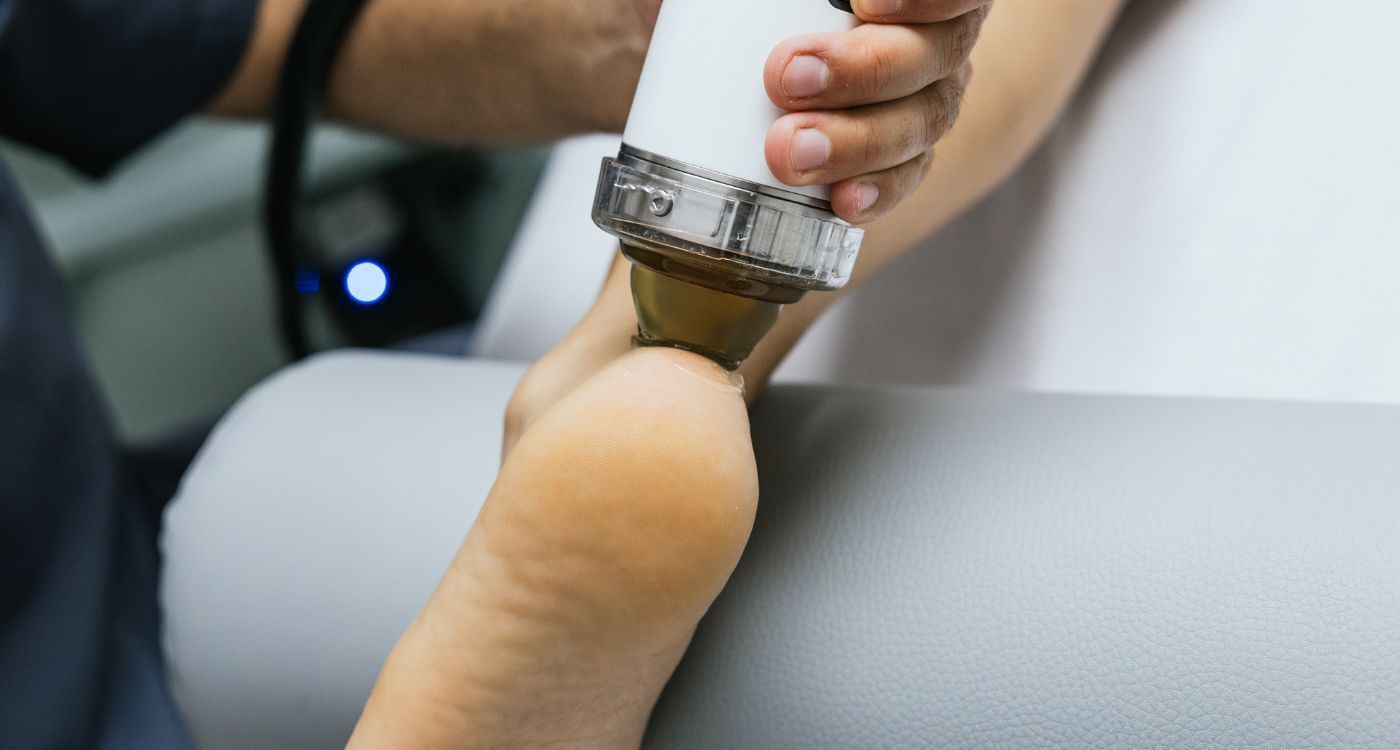
Shockwave therapy delivers high-energy acoustic waves through the skin directly into the damaged tendon tissue. These waves create a mechanical stimulus that does several things at once: it increases local blood flow into an area that is naturally poorly vascularised, breaks down calcific deposits that can form within or around the tendon, and triggers the release of growth factors that promote genuine collagen regeneration.
In practical terms, the treatment targets the problem at a tissue level rather than just managing the symptoms above it. A 2020 systematic review in the British Journal of Sports Medicine found shockwave therapy produced significant improvements in pain and function for Achilles tendinopathy, with results that held up at medium and long-term follow-up. The evidence base for shockwave in Achilles conditions is now strong enough that it appears in several international clinical guidelines as a first-line recommendation before surgical intervention is considered.
Focused Shockwave vs. Radial Shockwave: Why It Matters for the Achilles
Not all shockwave devices deliver the same treatment. Radial shockwave disperses acoustic energy broadly at the surface level, which is useful for some conditions but imprecise for tendon work. Focused shockwave, like the MyACT (Myofascial Acoustic Compression Therapy) technology used at Gold Hill Chiropractic and Natural Healing in Fort Mill, concentrates acoustic energy at a specific tissue depth.
For Achilles tendinopathy, this distinction is clinically meaningful. The degenerated tissue in mid-portion tendinopathy sits at a precise depth within the tendon. Insertional tendinopathy involves a specific attachment point at the calcaneus. Focused shockwave allows Dr. Jeremy Hozjan to target those exact structures rather than applying a generalised stimulus to the surrounding area.
What to Expect From Treatment
A typical course of shockwave therapy for Achilles tendinopathy involves four to six sessions, scheduled approximately once per week. Each session takes around 10 minutes. During treatment, most patients feel a deep pressure sensation and some localized discomfort at the site of tendon damage, which is expected and indicates accurate targeting. There is no downtime and most patients return to normal activity the same day.
Improvement typically begins to appear between sessions two and four, with continued tissue repair over the weeks following the final session. Chronic Achilles tendinopathy treatment often requires the full course before meaningful changes are felt, as the rebuilding of tendon collagen takes time, but the results tend to be durable.
At Gold Hill Chiropractic, Dr. Hozjan also assesses contributing factors such as calf muscle tightness, ankle mobility, and lower limb biomechanics, which can place ongoing load on the Achilles even during recovery. Where relevant, shockwave is combined with chiropractic or soft tissue work in the same session.
Who Is a Good Candidate?
Shockwave therapy is most effective for people who have been dealing with Achilles tendinopathy for more than six weeks and have not found lasting relief through rest, stretching, or physiotherapy alone. It is suitable for both mid-portion and insertional presentations, though the treatment approach differs slightly between the two.
If you have been told your only remaining option is surgery, shockwave is worth exploring first. The evidence for shockwave as an alternative to surgical intervention in chronic Achilles tendinopathy is well-established, and a number of patients who have been on surgical waiting lists have resolved their symptoms with a course of focused shockwave instead. You can read more about the shockwave therapy services at Gold Hill Chiropractic to understand the full range of conditions treated.
Taking the Next Step
Achilles tendon pain relief doesn't have to mean living with modified activity forever. If your Achilles has been stopping you from running, hiking, or simply getting through a full day on your feet without pain, focused shockwave therapy gives the tendon the biological signal it needs to actually repair.
Gold Hill Chiropractic and Natural Healing is located at 1824 Gold Hill Road, Fort Mill, SC, serving patients from Fort Mill, Tega Cay, and Rock Hill. Dr. Jeremy Hozjan offers same-day appointments with treatment beginning on your first visit.
Book an appointment online or call us at (803) 992-2484 to find out whether shockwave therapy is right for your Achilles.
%20(1400%20x%20750%20px)%20(51).jpg)